

Why a SIEM Is Practically Useless Without Proper Logging
In many organizations, the SIEM is treated as the heart of the Security Operations Center (SOC) — the place where every security event is supposed to be collected, analyzed, and correlated.
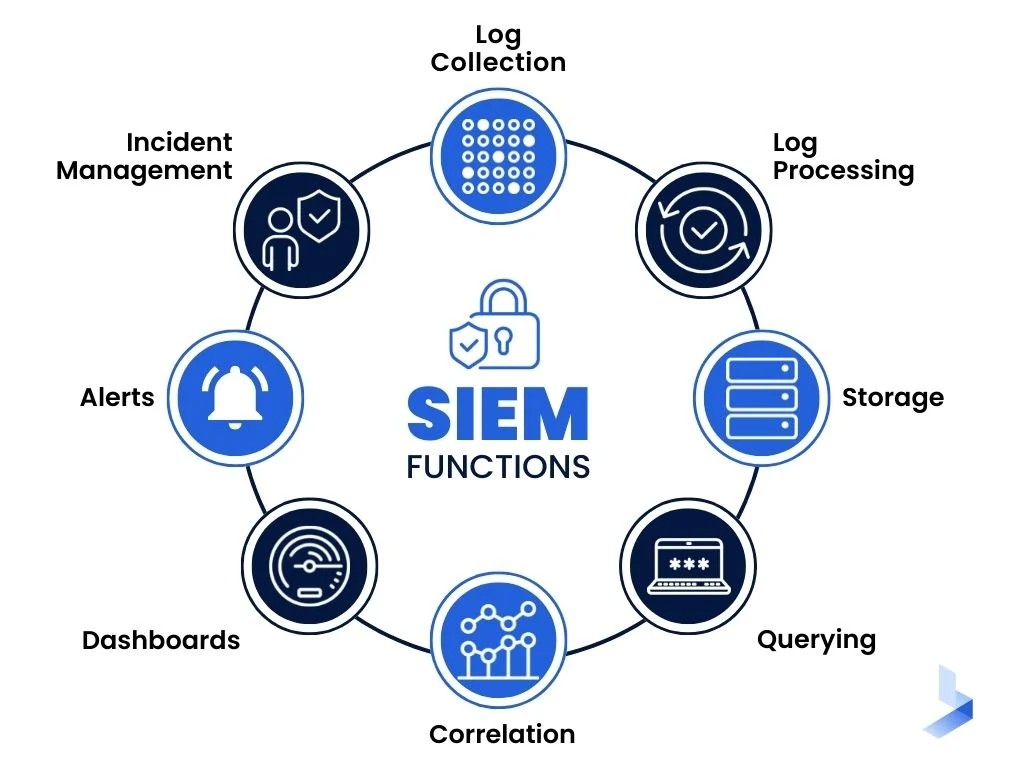
In many organizations, the SIEM is treated as the heart of the Security Operations Center (SOC) — the place where every security event is supposed to be collected, analyzed, and correlated.
The uncomfortable truth is simpler than that: a SIEM is only as good as the logs it receives. Deploy one without a real logging strategy, and what you get isn't a security control — it's a noisy dashboard full of incomplete alerts and a false sense of coverage.
What a SIEM Actually Does
A SIEM doesn't generate data — it interprets data. It doesn't see, listen, or log anything on its own; it only analyzes what other systems send it. In practice, its job breaks down into four stages:
1. Log collection. The SIEM ingests events from operating systems, firewalls, network devices, identity services, endpoints, and applications. If a source doesn't send logs — or sends incomplete ones — that event effectively never happened, as far as the SIEM is concerned.
2. Normalization. Logs arrive in inconsistent formats with mismatched field names from different vendors. The SIEM maps all of this into a common schema so it can be analyzed — but it can only normalize what actually exists. It can't infer or reconstruct a field that was never logged in the first place.
3. Correlation. This is the SIEM's real value: connecting individually harmless-looking events into a recognizable attack pattern. But correlation depends heavily on context — who the user was, where they logged in from, what process ran, what network connection was made. Without that context, correlation degrades into shallow pattern-matching that can neither reliably catch attacks nor recognize normal behavior.
4. Alerting. Alerts are the SIEM's output, not its starting point. Alert quality is a direct function of input quality — garbage in, garbage out. Even sophisticated detection rules produce nothing but misleading or worthless alerts when run against incomplete logs or stripped-down events.
Problem One: No Real Visibility
Without proper logging, a SIEM has genuine blind spots. Common examples:
- PowerShell activity without script block logging
- NTLM authentication without detailed event data
- RDP sessions without session and logon-type logging
- Firewall logs limited to simple allow/deny with no context
- Endpoint activity without command-line logging
The practical consequence: an attacker moves through the environment, escalates privileges, and leaves a trail — but because the SIEM never received meaningful logs, none of it registers. The incident isn't discovered when it happens; it's discovered after the attacker has already reached their objective, by which point the cost of response has multiplied.
Correlation Without Context Is a Blind Alarm
Correlation rules need context, not just event IDs. Take two classic Windows events: 4624 (successful logon) and 4688 (process creation). Without accompanying details — logon type, source IP, parent process, command line, privilege level — the SIEM only knows that a log arrived, not what actually happened.
Too Many False Positives Means an Unused SIEM
When logs are incomplete, the SIEM can't distinguish normal behavior from suspicious behavior, rules get oversimplified to compensate, and the SOC drowns in low-value alerts. The direct result is alert fatigue: analysts start tuning out noise, real alerts get missed among it, and trust in the SIEM erodes.
Threat Hunting Without Logs Is Effectively Impossible
Threat hunting runs on hypotheses, not alerts. Without process trees, DNS query logs, network flow data, authentication trails, and file access logs, hunting turns into blind guesswork. A SIEM starved of proper logs kills hunting capability, keeps the SOC purely reactive, and leaves the blue team permanently a step behind attackers.
Bad Logs Mean Failed Forensics
In incident response, the first question is always "what happened?" Without proper logs, there's no reliable timeline, no clear root cause, an ambiguous blast radius, and an incomplete incident report. From a management perspective: if you don't know what happened, how can you be confident it won't happen again?
Why Some SIEMs Get a Bad Reputation
Often the SIEM itself isn't the problem — the real issues are:
- Wrong or missing log sources
- Logging levels set too low
- Logging disabled for performance reasons
- No clearly defined use cases
- Logs collected without a specific security goal in mind
Teams conclude "the SIEM doesn't work," when in reality a SIEM is only ever as smart as the data it's given.
What "Proper Logging" Actually Looks Like
Good logging is:
- Complete — not just an event ID, but full surrounding detail
- Context-aware — includes user, host, IP, and command information
- Searchable — structured, not free-form
- Trusted — untampered and reliable
- Aligned to specific security use cases
A practical minimum baseline includes:
Windows: 4624/4625 with full detail, 4688 with command-line data, PowerShell script block logging
Network: DNS logs, NetFlow
Endpoint: process creation, file write events
Identity: authentication failures, privilege escalation events
The Real Fix: From Better Logging to SIEM + EDR Synergy
An ineffective SIEM isn't solved by replacing the tool — it's solved by fixing the data feeding it. The real solution is building a coherent chain from visibility through to analysis.
1. Treat logging as a security layer, not a side setting. Before writing rules or building dashboards, ask: what behaviors do we actually need visibility into? Logging should be use-case-driven, log levels should be set around attack scenarios rather than pure performance concerns, and logs need to carry operational context — not just event IDs. Skip this step, and the SIEM remains a consumer of incomplete data no matter how good its rules are.
2. SIEM without EDR means central visibility with no behavioral detail. A large share of modern attacks are fileless, rely on living-off-the-land techniques, and play out at the endpoint level. EDR fills exactly this gap — process trees, command lines, memory behavior, parent-child process relationships, user context. Once this data flows into the SIEM, correlation moves from theoretical to genuinely actionable.
3. EDR doesn't replace the SIEM — it complements it. EDR sees behavior in real time, enables fast containment, and gives deep endpoint visibility, but it lacks organization-wide visibility and doesn't fully cover network and identity data. Feed EDR data into a SIEM, and endpoint attacks become visible at the organizational level, correlated with network and identity signals, turning hunting from single-point investigation into multi-layered analysis.
4. The right architecture: EDR + Logging + SIEM. Rather than relying blindly on any single tool, a mature security model builds this chain:
Endpoint / Network / Identity
        ↓
  Logging with context
        ↓
   EDR (behavior)
        ↓
   SIEM (correlation)
        ↓
Detection, Hunting, Incident Response
In this model, the SIEM makes decisions, EDR provides sharp-eyed visibility, and logging is the backbone holding the whole system together.
Bottom Line
A SIEM without proper logging just produces a tired analyst staring at noise. EDR without a SIEM just gives you a narrow, local view. Effective security only emerges when solid logging, behavioral EDR data, and SIEM-driven correlation work together.
What's Your Reaction?
 Like
0
Like
0
 Dislike
0
Dislike
0
 Love
0
Love
0
 Funny
0
Funny
0
 Wow
0
Wow
0
 Sad
0
Sad
0
 Angry
0
Angry
0